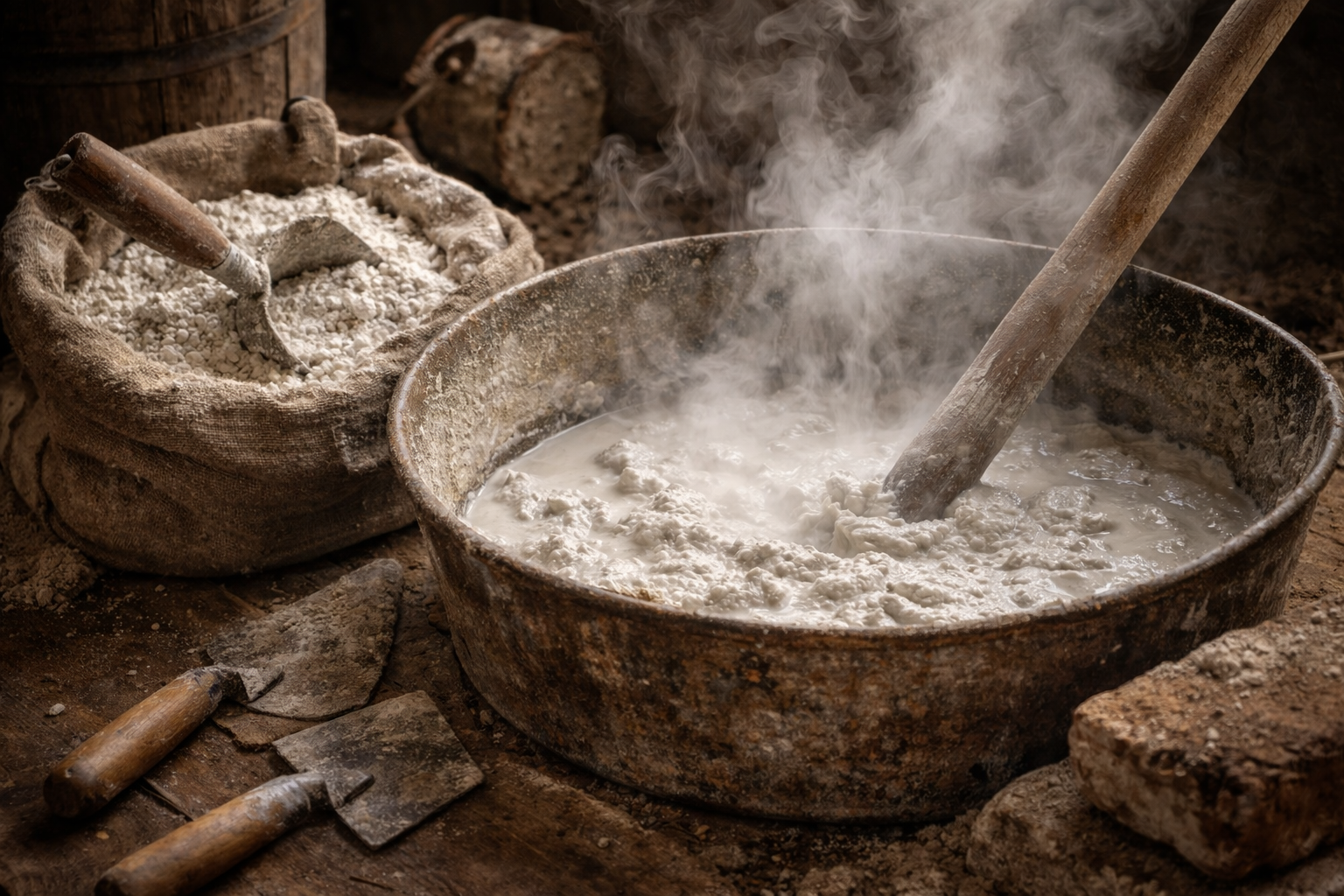
Hot lime mortar is a traditional construction material that has been used extensively in historic masonry across the British Isles and beyond. Produced by mixing quicklime with aggregate and water at the point of use, it differs fundamentally from modern lime putty and cement-based mortars. Understanding its properties and behaviour is essential when assessing historic fabric and planning appropriate repair strategies.
What is hot lime mortar?
Hot lime mortar is created by slaking quicklime directly with sand and water, generating heat as part of the chemical reaction. This process results in a mortar that is workable at high temperatures and begins to carbonate rapidly once placed. Historically, the method allowed mortar to be mixed and used on site, often as part of large-scale building or repair campaigns.
The characteristics of hot lime mortar are influenced by several factors, including the quality of the lime, the aggregate used, and the proportions of the mix. These variables mean that historic mortars can vary considerably in appearance and performance, even within a single building.
Properties and performance
One of the defining features of hot lime mortar is its permeability. Unlike dense, modern cement-based mortars, hot lime allows moisture to pass through the masonry, enabling evaporation and reducing the risk of trapped damp. This property is particularly important in solid-walled historic buildings, where moisture movement is a normal and expected condition.
Hot lime mortars also tend to be more flexible than modern alternatives. This flexibility allows masonry to accommodate minor movement without cracking, which is especially relevant in older buildings constructed without rigid foundations or movement joints.
Historic use
Historically, hot lime mortar was widely used for bedding masonry units, pointing, and sometimes rendering. Its rapid initial set allowed work to proceed efficiently, while the long-term carbonation process contributed to the durability of the finished masonry. Evidence of hot lime mortar can be found in a wide range of historic structures, from vernacular buildings to more formally designed architecture.
Over time, the use of hot lime declined as industrially produced materials and cement-based mortars became more readily available. In many cases, later repairs introduced incompatible materials that altered the way historic masonry performed.
Hot lime in a conservation context
In conservation practice, the use of hot lime mortar is considered where it aligns with the original construction methods and material behaviour of a building. Its compatibility with historic masonry can help reduce long-term damage caused by rigid or impermeable repair materials.
However, hot lime mortar is not a universal solution. Its use requires an understanding of traditional techniques, appropriate site conditions, and skilled workmanship. Careful assessment is necessary to determine whether hot lime is suitable for a particular building, location, or type of repair.
Conclusion
Hot lime mortar remains an important material within the conservation of historic buildings, offering properties that are often better suited to traditional masonry than modern alternatives. When used appropriately, it can contribute to the long-term performance and preservation of historic fabric. As with all conservation interventions, its use should be informed by a thorough understanding of the building, its materials, and its history.
Leave a Reply